
How to Search Criminal Dockets
Start with the court, not a broad name search. Georgia E-Access to Court Records lists Turner Superior and Turner State Court separately, then routes both to PeachCourt. That provider requires an account before its case-search controls appear. The public login screen does not prove which filters, documents, or prices will be available after sign-in. For a no-login date search, use the Tifton Judicial Circuit calendar and daily schedules. Then ask the Turner County Clerk of Superior Court for the docket register or named filing.
Have the exact court, case number, approximate year, record type, and hearing date ready. A name alone can match more than one person. Criminal case numbers observed in an official Superior Court sample use a year plus CR pattern, but State, city, and other courts may format numbers differently.
- Decide whether the matter belongs to Superior Court, State Court, or a municipal court.
- Check the public circuit schedule for a Superior Court date or case number.
- Use Georgia E-Access and follow the correct Turner court link to PeachCourt if account access is suitable.
- Compare the court, year, and case number before reading any entry.
- Contact the proper clerk for a filed order, disposition, or certified copy.
Turner Criminal Docket Routes
Turner County Superior Court is the main route for felony filings and Superior criminal calendars. Turner County State Court handles misdemeanors, including traffic cases bound over from a Turner municipality. A city citation may begin in Ashburn or Sycamore Municipal Court and later move to State Court. The citation or latest court notice controls where the matter is pending.
The official Turner State Court page documents that jurisdictional split. Its captured view also gives useful context for the Turner County criminal docket:
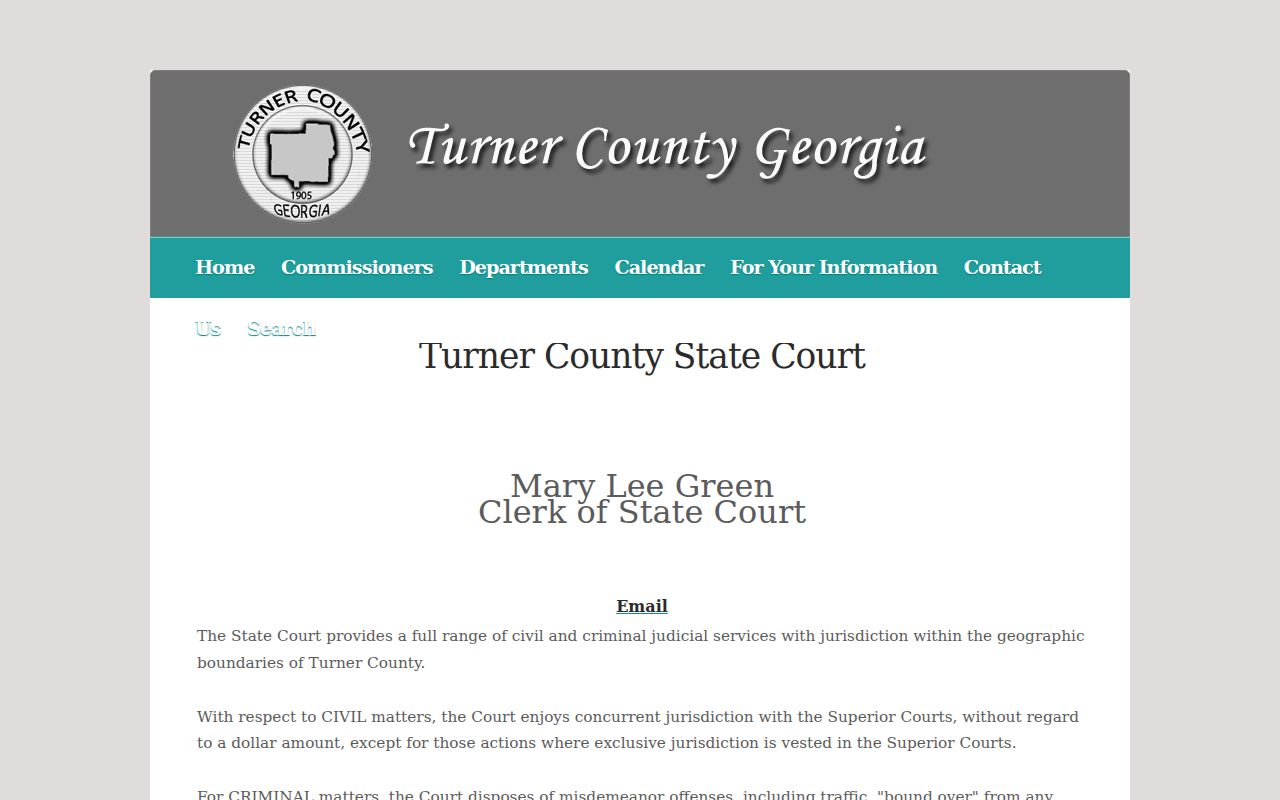
The image reinforces why a misdemeanor search should not begin in a Superior-only calendar and why the current court must be confirmed.
What a Criminal Docket Shows
A Turner County criminal docket can identify filings and procedural events, while a public calendar shows only the scheduled layer. Official Turner Superior samples include the court and county, judge, calendar date and time, case number, count, alleged offense description and classification, offense date, attorney-side field, and print metadata. Other schedules use labels for arraignments, bond hearings, probation matters, warrants, pleas, and continuances. Those labels must be read as settings until the filed order shows what occurred.
| Case number | Superior samples use year plus CR; the full identifier is needed for a reliable match. |
|---|---|
| Count and charge | A listed allegation and its classification, not a finding or conviction. |
| Setting | An arraignment, hearing, calendar call, trial calendar, or other scheduled event. |
| Filed event | A motion, plea, order, or other entry recorded in the clerk's register. |
| Disposition | The procedural or merits outcome, which must be confirmed in the docket or order. |
Turner Criminal Calendar Language
Calendar wording can be easy to overread. A “criminal hearing” gives a setting type, not the result. “Motion to revoke bond” means a motion was scheduled. It does not state that bond was revoked. The same care applies to probation revocation, bench warrant, asset forfeiture, and guilty plea settings.
- Calendar call
- A scheduled review or call of cases, often before a later hearing or trial date.
- Arraignment
- A proceeding at which a charge and plea process are formally addressed.
- Continuance
- A request or order that moves a setting; the calendar alone may not show whether it was granted.
- Disposition
- The recorded outcome, found in the docket or filed order rather than inferred from a setting.
Even the word “felony” on a Turner County criminal calendar is a classification of an alleged charge. It is not a conviction. Neutral reading protects the accuracy of any public-case research.
Stages on a Criminal Docket
A Turner County criminal docket builds over time. A filed charge may be followed by arraignment, motions, pretrial settings, a plea or trial event, disposition, and sentencing. Not every case takes every step, and a calendar may list only one point in that sequence. A calendar entry also may change after a PDF is produced.
Docket flow: Filing › Arraignment › Pretrial › Plea or Trial › Disposition › Sentencing
Use the docket register to trace that flow. Request the charging document or order when the text of a filing matters. A certified copy is a separate product and should be named as such when contacting Mary Lee Green, Clerk of Superior Court.
If the record does not appear online, ask whether it is paper-only, archived, sealed, redacted, or held by another court. The Clerk publishes a mailing address and fax, but no official Turner source confirms that every criminal-record request can be completed by either channel. Call first to verify current hours, accepted request methods, copy and certification charges, identification needs, and payment. Do not send private identifiers to an address that the court has not confirmed.
Turner Criminal Daily Schedules
The Tifton Judicial Circuit Daily Schedules page is the main no-login document route found for current Superior settings. Its files are grouped by judge and year. Turner documents include criminal calendar calls, arraignments, hearings, reserve days, probation matters, and trial calendars. Search the file names for Turner, then verify the newest document and its printed date.
This route helps find a case number or hearing date. It is not a criminal-history database. It does not replace PeachCourt or the clerk's file, and a later reset may not be reflected in an older PDF. Call the court when the date is close or travel depends on the setting.
Which Court Holds Criminal Dockets
Superior Court holds Turner felony matters. State Court holds misdemeanors and traffic cases bound over from municipalities. Ashburn and Sycamore courts may hold a city ordinance or traffic matter before transfer. Juvenile records follow a restricted route even though the clerk directory lists Juvenile among Clerk-managed courts.
For Superior and State matters, the Turner County Clerk of Superior Court is the local records contact. The Georgia E-Access directory is the provider gateway, and the Tifton circuit publishes Superior calendar material. Municipal clerks keep their own streams. Asking the wrong office can produce a blank result even when the case exists.
Turner Grand Jury Context
A historic Turner County Grand Jury presentment offers aggregate context without exposing private captions. The 2016 presentment reported indictment totals for that term. It is not a current caseload report, but it shows that aggregate court activity and a case-level docket answer different questions.
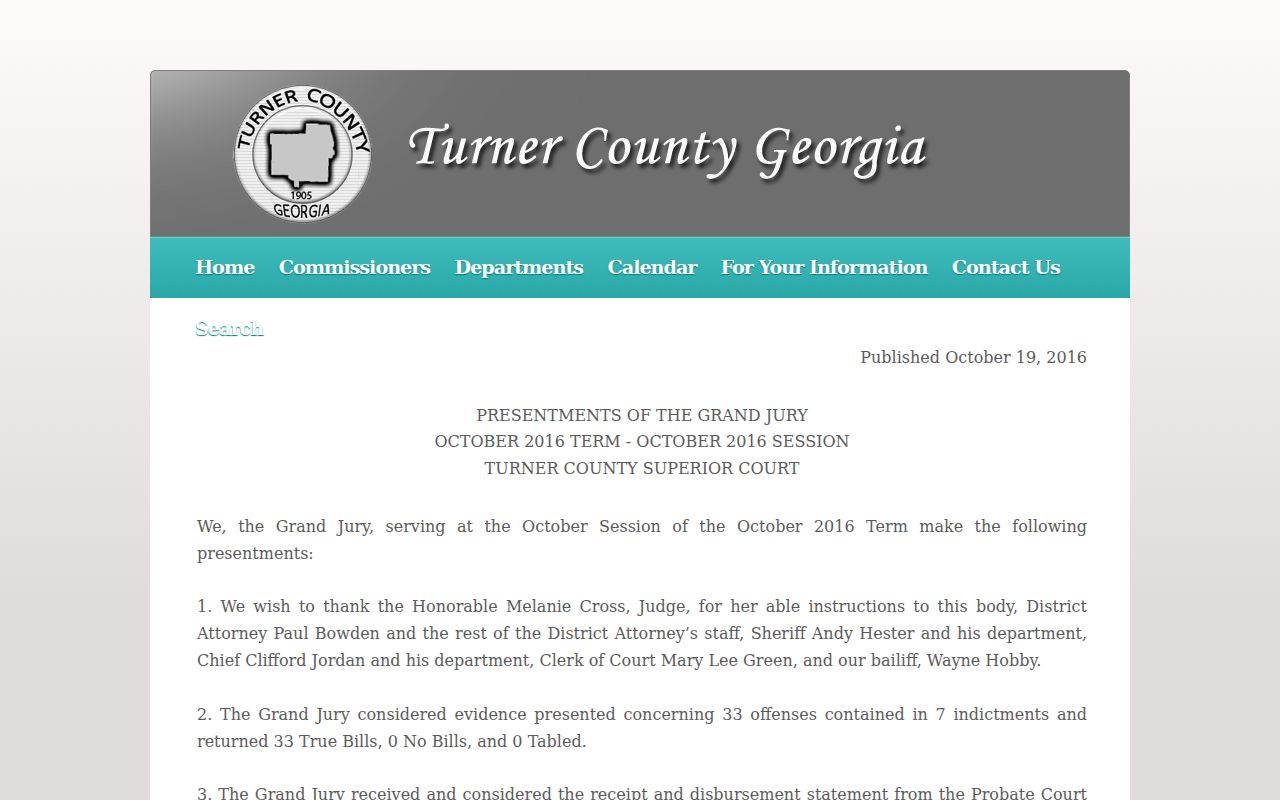
The archived notice can describe past institutional activity. It cannot show the status, filings, or outcome of a current Turner County criminal case.
Public Access and Sealed Criminal Dockets
Georgia court records are generally open for inspection unless law or court procedure limits access. Turner County's Clerk page states that juvenile, adoption, and military-discharge records are not available to the general public. Sealed filings, protected identifiers, and other confidential material may also be withheld or released only in redacted form. A public calendar event does not make every underlying filing public.
Key rules:
Uniform Superior Court Rule 21 provides public inspection as the baseline and procedures for restricting court records.
Rules 21.6 and 36.17 address sealed filings and protected personal identifiers.
The county clerk's access notice places juvenile and adoption records outside the general public route.
Ask for the public or redacted version of a specific record. If it cannot be released, ask which rule or order controls. A missing online result does not prove that a case never existed; it may be sealed, archived, paper-only, restricted, or filed in another Turner court.
Turner Criminal PeachCourt Access
PeachCourt is both the provider linked for Turner Superior and State records and Georgia's mandatory e-filing system for those courts. Filing access and public document access are related, but they are not the same workflow. The public screen shows email, password, registration, and password-recovery controls before login. It does not expose criminal search fields.
Do not promise free access or complete document coverage. If an account search fails, return to the latest circuit schedule and the Clerk. State the court and exact record sought so staff can distinguish a calendar entry from a charging paper, order, disposition, or certified copy.